
India has never lacked craft. It has lacked brands that turn craft into meaning the market will pay a premium to own. Two houses show how it’s done — and Forbes India recently asked me why.
The question Forbes put to me
For its July anniversary issue, Forbes India set out to examine the Indian brands earning a place on the world stage. They asked me to assess two of them — Good Earth and Jaipur Rugs — and specifically, what gives each its sustained pricing power. The answer, in both cases, turned out to be the same thing, and it is not the thing most people assume. It is not the craft. India has never been short of craft. It is what these two houses built around the craft — and refused to let anyone else own.
Good Earth sells an interpretation of India
Walk through a Good Earth store and you are not looking at product categories. You are looking at a world. Tableware became textiles, textiles became candles and glassware, and each expansion emerged less from category planning than from the desire to create a complete, coherent universe. A plate with pomegranates, a length of khadi, a scented candle — individually ordinary objects, collectively a philosophy.
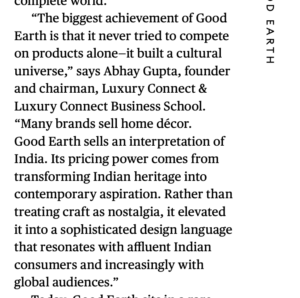
This is what I told Forbes, and I will say it more plainly here. Most brands in this category sell home décor. Good Earth sells an interpretation of India. Its pricing power comes from transforming Indian heritage into contemporary aspiration — not treating craft as nostalgia, but elevating it into a design language sophisticated enough to resonate with affluent Indian consumers and, increasingly, global ones.
That distinction is the whole game. Décor is a product. An interpretation of India is meaning — and meaning is almost impossible for a competitor to copy, because they would have to reproduce not the object but the decades of consistency behind it.
Jaipur Rugs and the authenticity most brands can’t manufacture
Jaipur Rugs arrives at the same destination by a different road. Its raw wool is sourced globally, hand-spun in Bikaner, dyed, designed, and delivered to a decentralised network of artisans — a model built decades ago that today remains its greatest strength.
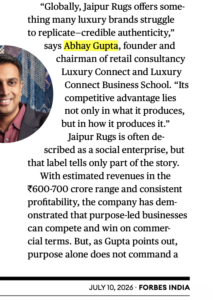
But the model is not the point. The point is what the model produces: something many luxury brands struggle to replicate — credible authenticity. Its competitive advantage lies not only in what it produces, but in how it produces it.
That last line matters more than it looks. In a market flooded with brands announcing their ethics, Jaipur Rugs is its ethics — the authenticity is structural, built into how every rug comes to exist, not applied afterward as a story. That is not a claim a competitor can match by writing a better sustainability page. It has to be built, artisan by artisan, over years.
The two lessons, and the one that unites them
Good Earth teaches that heritage must become living culture — reinterpreted for how people actually live, never preserved as museum nostalgia. Jaipur Rugs teaches that purpose can command a premium, but only when it sits on genuine excellence — impact opens the conversation; design and craftsmanship close the sale.
Different lessons, same underlying truth. Both houses stopped competing on the object and started owning a meaning. Good Earth owns an interpretation of India. Jaipur Rugs owns credible authenticity. Neither can be copied, because neither lives in the product — it lives in decades of consistent, disciplined decisions that a rival cannot compress.
What this means for the next generation
The future of Indian luxury will not be built by imitating European maisons, and it will not be built by producing more artisans. We already have the artisans — that was never the gap. It will be built by more Indian brands doing what these two did: taking craft the country has always had, building a distinct cultural meaning around it, and owning that meaning with enough discipline that no one else can take it.
India has never lacked craftsmanship. It has lacked globally scaled luxury brands built around that craftsmanship. Good Earth and Jaipur Rugs are proof the gap can be closed. The question for every founder reading this is whether they are building a product — or a meaning worth paying a premium to own.
This blog was first posted at https://www.abhaygupta.in/custodians-of-meaning-what-good-earth-and-jaipur-rugs-know-that-most-indian-brands-dont/